You have finished your manuscript, and now a practical question appears: should you publish it as an ebook, a paperback, or both?
Many first-time authors assume there is one correct answer. There is not. The right choice depends on your genre, your goals, your budget, and your readers.
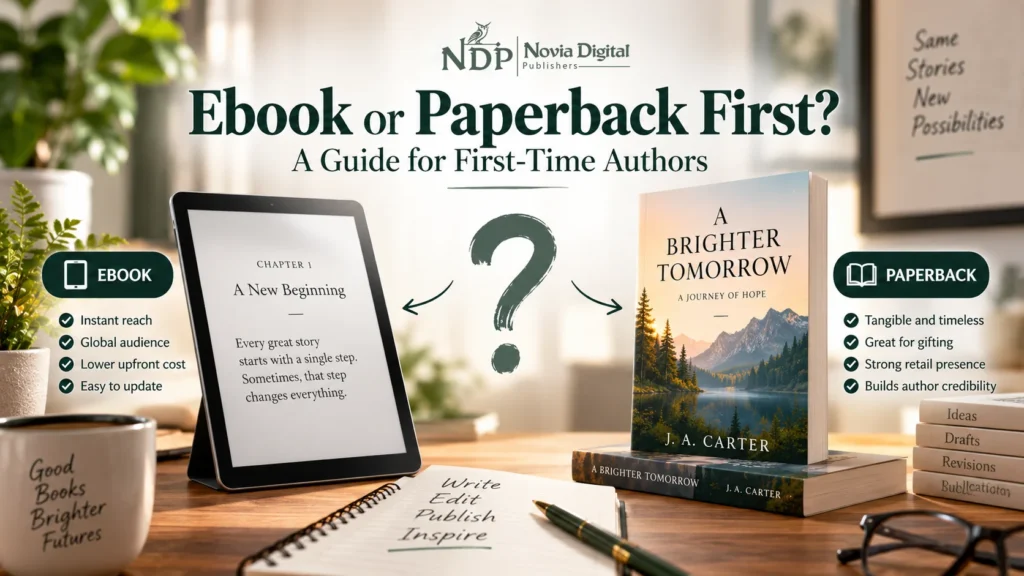
This guide compares ebook vs paperback for authors, explains the real differences, and helps you decide what to publish first.
The Short Answer
If you are on a tight budget, want to publish quickly, or want to test the market, an ebook is often the simpler place to start. If your book is something readers like to hold, gift, or display, or if you plan to sell at events, a paperback may matter more.
Many authors publish both. The question is usually not “which one,” but “which one first, and when to add the other.”
What Is an Ebook?
An ebook is a digital file that readers open on a Kindle, phone, tablet, or computer. It does not need to be printed, shipped, or stored.
Strengths:
- No printing process, so the production side is often simpler
- Instant delivery to readers anywhere
- Easy to update if you need to fix errors or revise content
- Flexible pricing
- Readers can carry many books on one device
Limitations:
- No physical copy to sign, gift, or display
- Some types of books, such as image-heavy or highly designed books, can be harder to present well
- Readers cannot easily lend or resell it the way they can with a printed book
What Is a Paperback?
A paperback is a printed book with a soft cover. Many authors publish paperbacks through print-on-demand, where copies are printed only when someone orders them.
Strengths:
- A physical product readers can hold, keep, and share
- Good for gifts, events, signings, and local sales
- Often adds a sense of credibility and completeness
- Works well for books that benefit from layout and illustrations
Limitations:
- Needs print-ready files, including a correct trim size and a full cover with spine
- A printing cost applies to each copy, which affects your pricing and earnings
- Changes after publishing require uploading new files, and proof copies are worth ordering
- Usually more preparation than an ebook
How They Differ Behind the Scenes
Formatting. An ebook is generally reflowable, meaning the text adjusts to each device. A paperback has a fixed layout, with set page sizes, margins, and page numbers. These are different jobs, and each has its own requirements.
Cover design. An ebook needs a front cover that also works as a small thumbnail. A paperback needs a full wraparound cover with front, spine, and back, and the spine width depends on your page count and paper. For more on this, see our guide to book cover design services.
Pricing and earnings. Print copies carry a printing cost, while ebooks do not. Your price needs to account for that difference.
ISBN and platform rules. Requirements can differ by format and platform, so check with your publishing platform or provider before you upload.
What Should You Think About Before Choosing?
Your genre. Reader habits vary by genre. Many readers of some fiction genres are comfortable with ebooks, while children’s picture books, cookbooks, and gift books often work better in print. Look at how similar books in your category are sold.
Your goals. Do you want fast publication, a book to sell at events, a credential for your business, or a long-term author brand?
Your budget. An ebook-first plan can lower the early workload, while a paperback adds design and proofing steps.
Your audience. Think about who will buy your book and how they read.
Your marketing plan. If you plan to speak, run workshops, or sell in person, a physical copy can be very useful.
Which Should You Publish First? Quick Scenarios
- First-time novelist testing the market: Start with an ebook, then add a paperback once you see interest.
- Business or expert book: Consider publishing both together, since a paperback can support credibility and speaking events.
- Children’s picture book: Paperback is often the main format, though an ebook can be added.
- Memoir for family and friends: Paperback is often the priority, since people like to hold and gift it.
- Image-heavy or workbook-style book: Prioritize print, and consider how the ebook will display layouts.
These are starting points, not rules. Your own situation matters most.
Publishing Both at the Same Time
Releasing both formats together can be practical. Readers can choose their preferred format, and on many platforms the formats can appear together on the same book page. It also means your launch marketing covers both.
The tradeoff is more upfront work, since you need both formatting types and a full cover. If that feels like too much, start with one and add the other later.
Common Mistakes to Avoid
- Assuming one format is always better. It depends on your book.
- Converting a print file into an ebook without checking. Ebook formatting should be done properly, not just exported.
- Skipping the proof copy. Always check a physical proof of your paperback before approving it.
- Forgetting printing cost when setting a price. Calculate your earnings per copy first.
- Using a cover that only works at full size. Check how it looks as a small thumbnail.
Frequently Asked Questions
Should I publish an ebook or paperback first?
It depends on your genre, budget, and goals. Ebooks are often simpler to start with, while paperbacks suit books that readers want to hold or gift.
Can I publish both formats?
Yes. Many authors do, either together or one after the other.
Do ebooks and paperbacks need different formatting?
Yes. Ebooks use reflowable text, while paperbacks need fixed page layouts with trim size and margins.
Is a paperback more expensive to produce?
Usually it needs more preparation and has a per-copy print cost, but print-on-demand means you do not need to print a large batch upfront.
Do I need a different cover for each format?
The design can be consistent, but the paperback needs a full wraparound cover with a spine, so the files are different.
Do I need an ISBN?
Requirements vary by platform and format. Ask your publishing platform or provider.
Final Thoughts
There is no universal winner in the ebook vs paperback debate. The best format is the one that fits your book, your readers, and your plans.
Think about how your readers will find and use your book, then choose a starting point you can do well. You can always add the other format later.
If you would like help with ebook formatting, paperback formatting, and cover design, Novia Digital Publishers (NDP) supports authors from manuscript to launch. Explore our self publishing services or contact us to talk about your book.